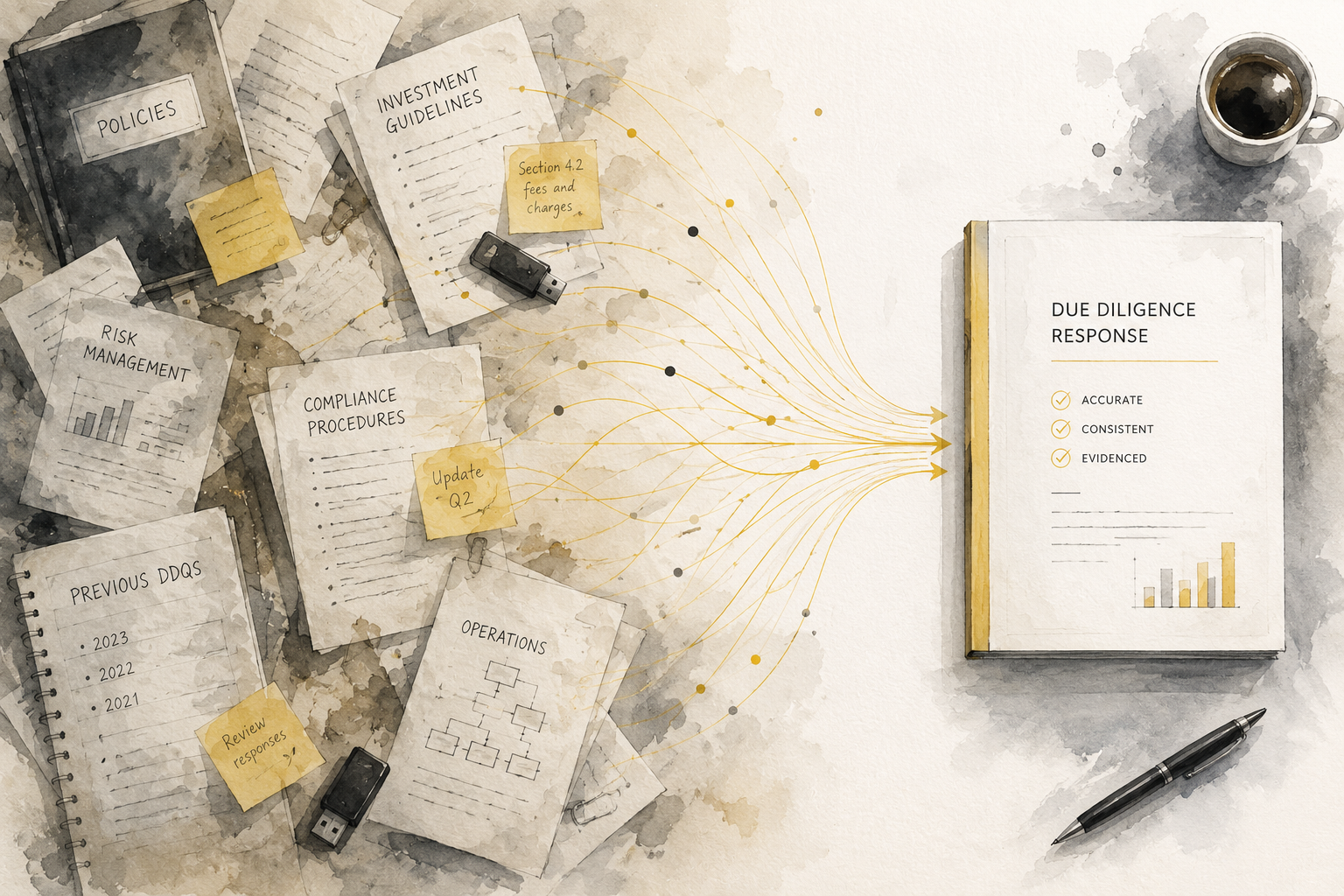
AI-Assisted Due Diligence Questionnaire Automation
Putting a live version in the hands of the clients within two weeks was incredibly important to build trust and facilitate quick feedback and iterations.
Due Diligence Questionnaire Automation
An investment management organisation was spending significant time completing recurring due diligence questionnaires. Much of the information already existed across policies, procedures and previous responses, but finding the right information and producing consistent answers remained a largely manual process.
The objective was to build an AI-assisted application capable of producing high-quality first drafts while keeping domain experts in control of the final output.
The problem
I was responsible for designing and delivering the initial version of the application along with subsequent iterations, covering backend and front end development, AI integration and the overall user workflow.
The first production version was delivered within two weeks, with the expectation that subsequent iterations would be driven by real user feedback rather than assumptions made upfront.
My role
Ruthless prioritisation
The first step was narrowing the scope to the smallest product capable of solving the core problem.
Rather than trying to automate every aspect of the DDQ process, the initial release focused on helping users generate high-quality draft responses with supporting evidence. Features that weren't essential to validating the concept were intentionally deferred.
Equally important was setting clear expectations with stakeholders about what would and wouldn't be included in the first release. By aligning everyone on the initial scope early, it became easier to maintain focus as new ideas emerged during development.
Understanding every user
Before building features, I spent time with each user group to understand how they approached the problem.
Instead of asking what functionality people wanted, conversations focused on how they currently worked, where time was being lost and what a successful outcome looked like from their perspective.
These discussions influenced everything from the retrieval workflow to how generated responses were presented for review.
Defining the problem before building the solution
A significant amount of time was invested before writing code.
Together with stakeholders, we worked to define what constituted a successful response, gathered representative examples and agreed on the outcomes the system needed to achieve.
This provided a much clearer benchmark for evaluating AI-generated responses and reduced ambiguity throughout development.
Approach
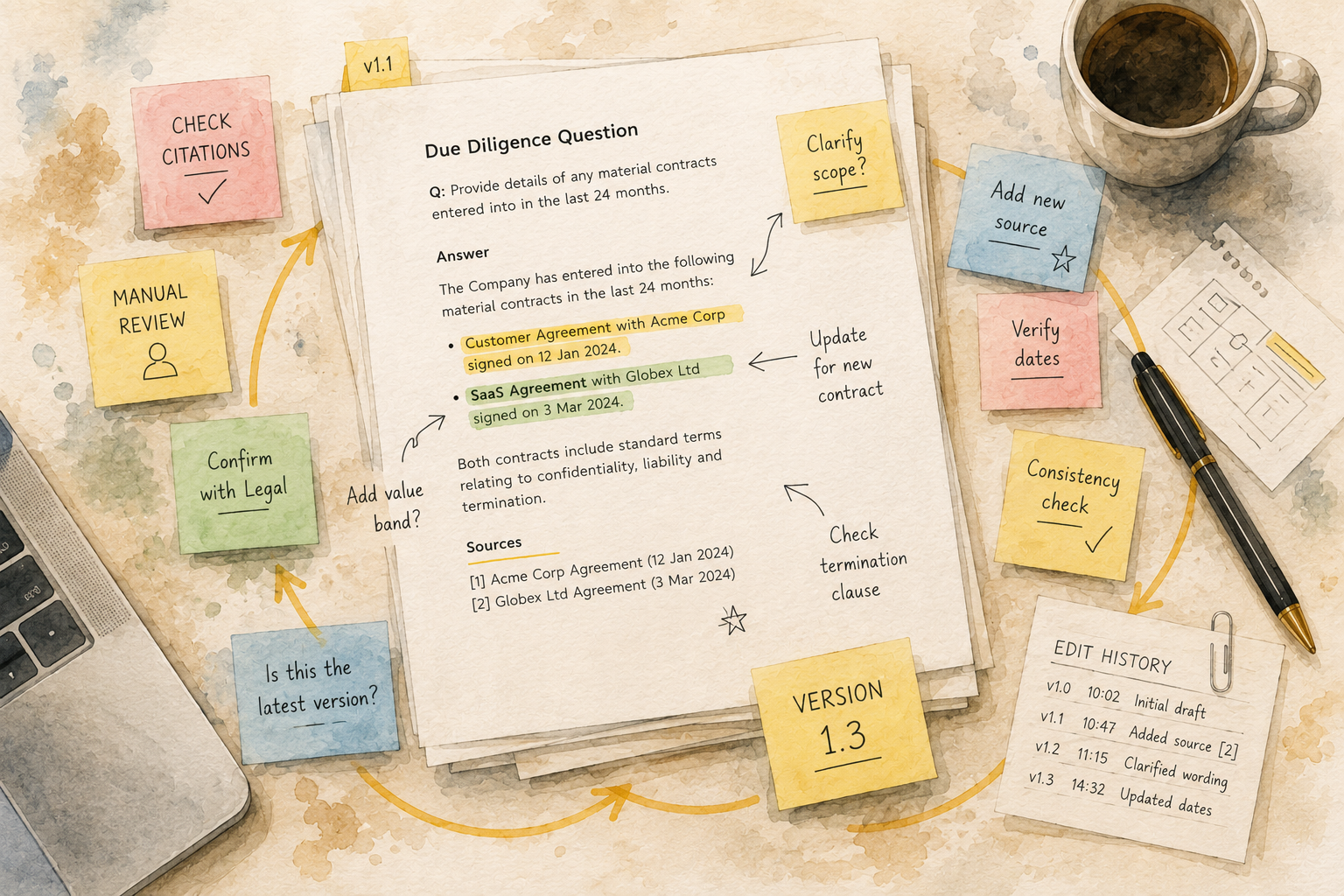
Multiple user groups with different priorities
The application served several distinct user groups, each with different expectations.
Investment professionals wanted trustworthy answers with clear supporting evidence. Administrators needed efficient ways to manage documents and maintain the underlying knowledge base. Other stakeholders were focused on delivery timelines and demonstrating value quickly.
Rather than optimising for one audience, the solution needed to balance all of these perspectives.
Limited time and resources
With only a short window to deliver an initial product, there wasn't enough time to build every feature that users requested.
This meant making deliberate trade-offs about what would create the greatest value in the first release while leaving room for future improvements.
Defining success
Like many AI projects, success wasn't immediately obvious.
Questions such as "What makes a good answer?" or "How accurate is accurate enough?" needed to be answered before implementation decisions could be made. Without clear examples and agreed expectations, it would have been difficult to measure whether the system was actually solving the problem.
Challenges
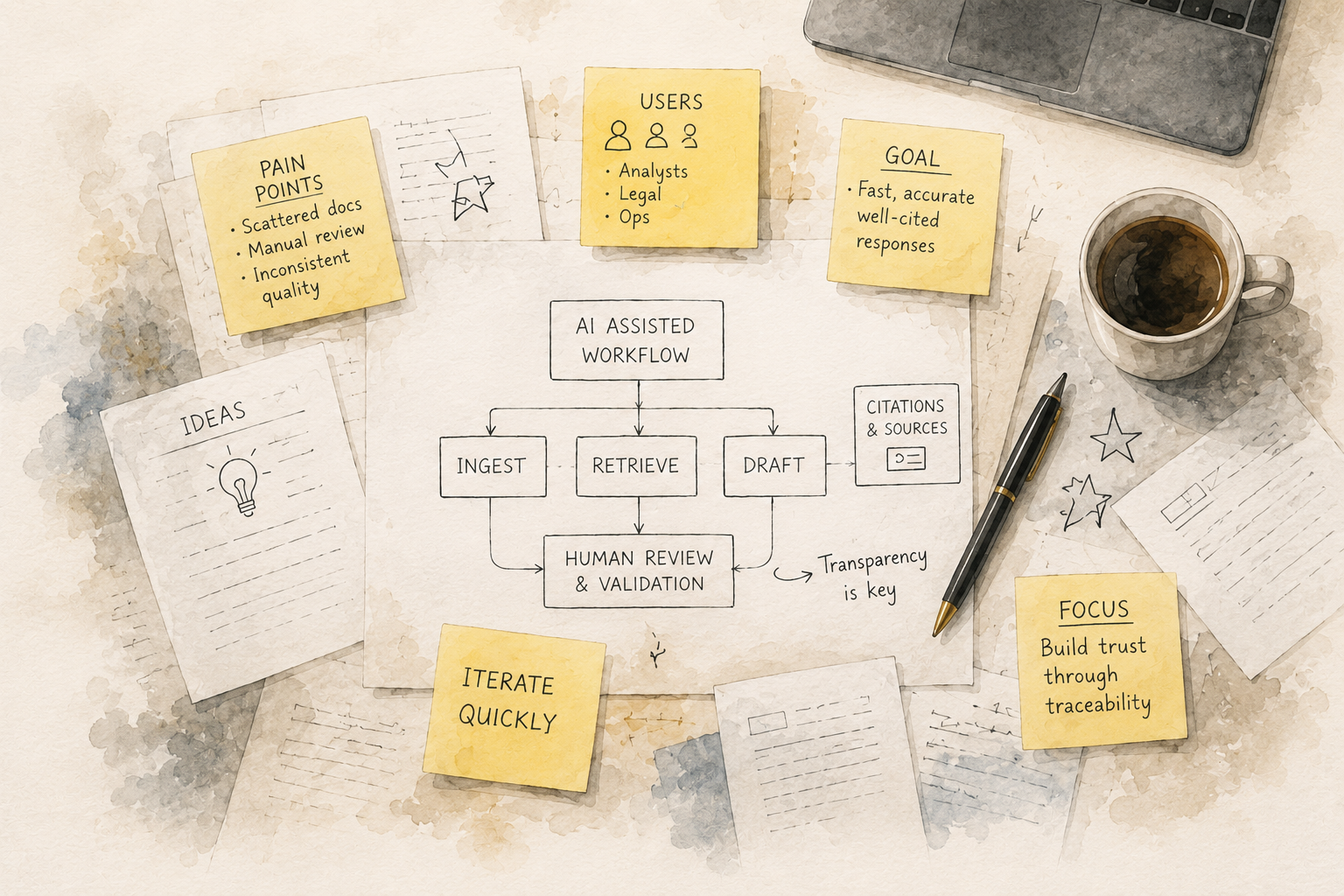
The initial version of the application was delivered within two weeks and provided users with an AI-assisted workflow for generating draft DDQ responses backed by relevant supporting information.
Most importantly, the project established a foundation that could be iteratively improved through real user feedback rather than attempting to solve every problem in the first release.
The outcome
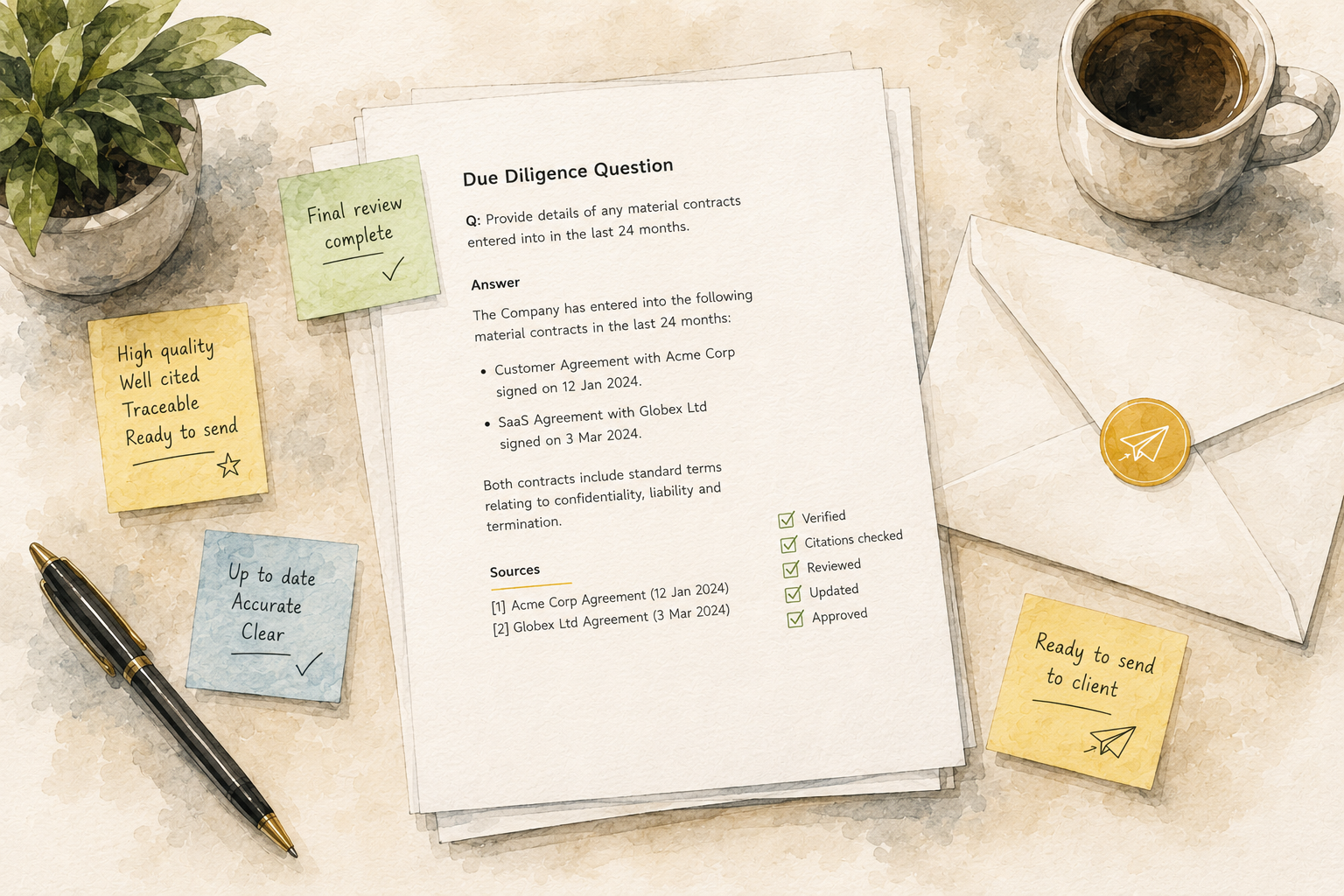
Early alignment saves time later
Investing time upfront to define the problem, agree on examples and establish success criteria prevented countless conversations later in the project. Particularly with AI systems, agreeing on what "good" looks like is often more valuable than selecting a particular model or technology.
Prioritisation is a product skill
When time and resources are constrained, every feature competes with delivery. Focusing on the smallest solution capable of delivering meaningful value allowed the project to reach users quickly and created better opportunities for learning.
Users rarely share the same definition of success
One of the biggest lessons was that successful software isn't built around features, but around people. Different users approached the same workflow with different goals, and understanding those perspectives early had a much greater impact on the final product than any technical decision.
What I learned
Start a conversation to learn more
Learn more about our other projects and how we can work together.